
What is Stanford Management Company?
Stanford Management Company (“SMC”) was established in 1991 as the University’s investment office to professionally manage the Merged Pool and other financial assets in accordance with the laws governing fiduciaries of charitable trusts, including the duties of care and loyalty. Through careful stewardship of the Merged Pool, SMC helps current and future students and scholars fully pursue their academic interests. SMC is a department within the University. Its staff are Stanford employees and include many graduates of the University. SMC is overseen by a Board of Directors appointed by Stanford’s Board of Trustees.
What is the Merged Pool and how is it different from the Stanford Endowment?
The Merged Pool is the University’s principal investment vehicle. Stanford invests a substantial majority of the University’s more than 9,000 endowed gifts, collectively referred to as Stanford’s Endowment, as well as other operating funds from Stanford’s hospitals, and funds that the University chooses to treat as long-term investments. Some of the University’s endowment is held in commercial lands and real estate near Stanford’s main campus and is not part of the Merged Pool.
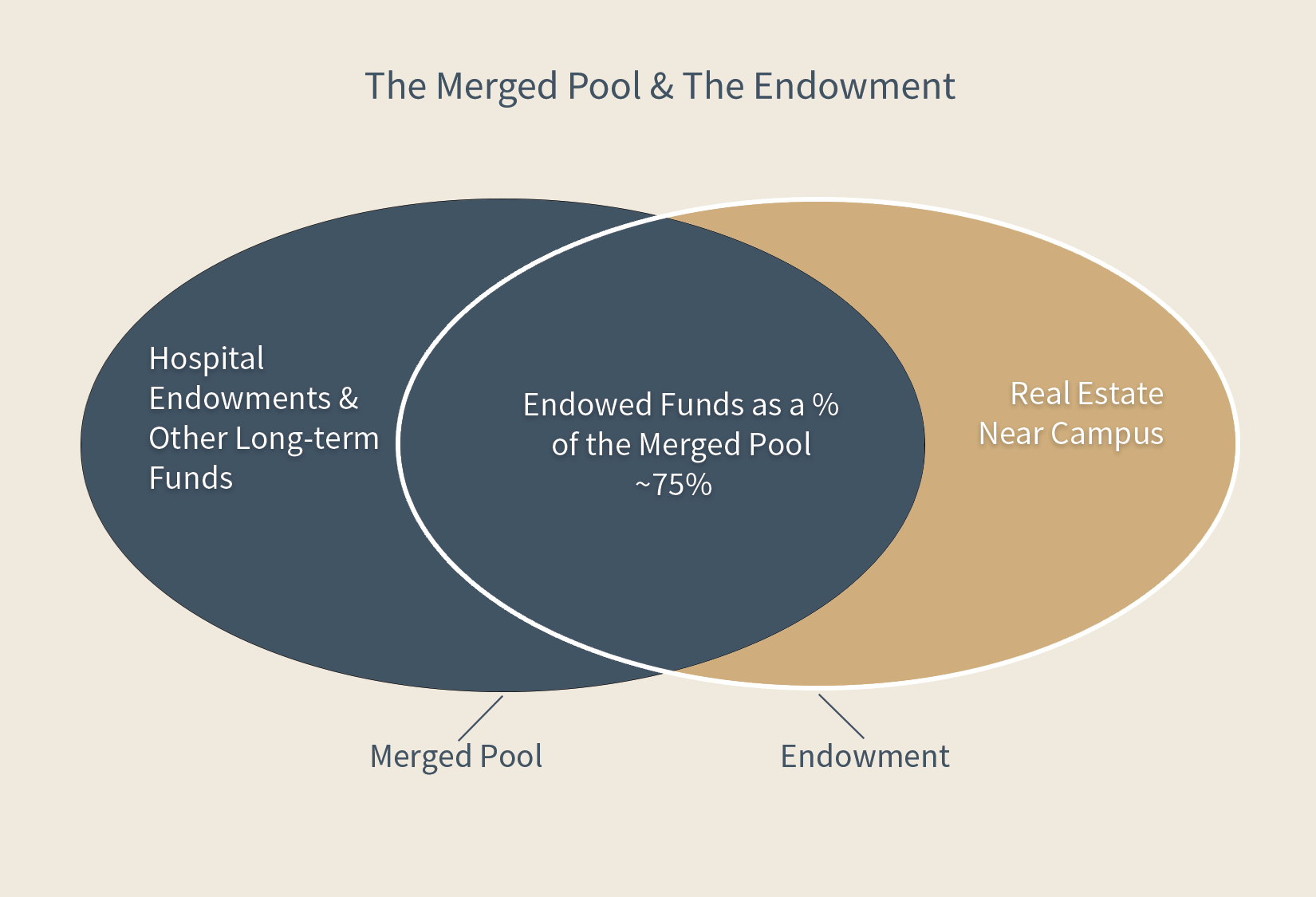
What is the Stanford Endowment?
Composed of more than 9,000 individual endowed gifts, donated by alumni and friends of Stanford since its founding in 1885. Endowed gifts support Stanford’s research and education mission by providing a valuable source of perpetual funding for student financial aid, faculty positions, scientific research, the arts and humanities, and innovations in healthcare and sustainability. Annual distributions from endowed gifts contribute approximately 20% of the University’s operating budget each year, benefiting students, faculty, and staff.

Who works at SMC?
SMC is led by Robert Wallace, who serves as SMC’s Chief Executive Officer and Chief Investment Officer. The SMC team is comprised of investment professionals as well as professional staff who perform the office’s operations, legal, IT, and administrative work.
How does SMC decide where to invest?
SMC’s investment strategy begins with two primary goals: to disburse meaningful amounts of the Endowment every year to support the University’s operating budget, and to preserve the value of the Merged Pool, adjusted for inflation and spending, so that it can continue to support future generations of students and scholars in perpetuity. These dual goals require an equity-oriented policy asset allocation that is capable of generating sufficiently high returns, while mitigating volatility and risk through careful diversification. SMC’s investment strategy incorporates a wide variety of asset categories, including public and private equity, real assets, fixed income, and certain hedge fund strategies. By combining these asset categories with care and discipline, SMC moderates the natural volatility of financial markets without compromising on expected investment returns. Read more about SMC’s asset classes.
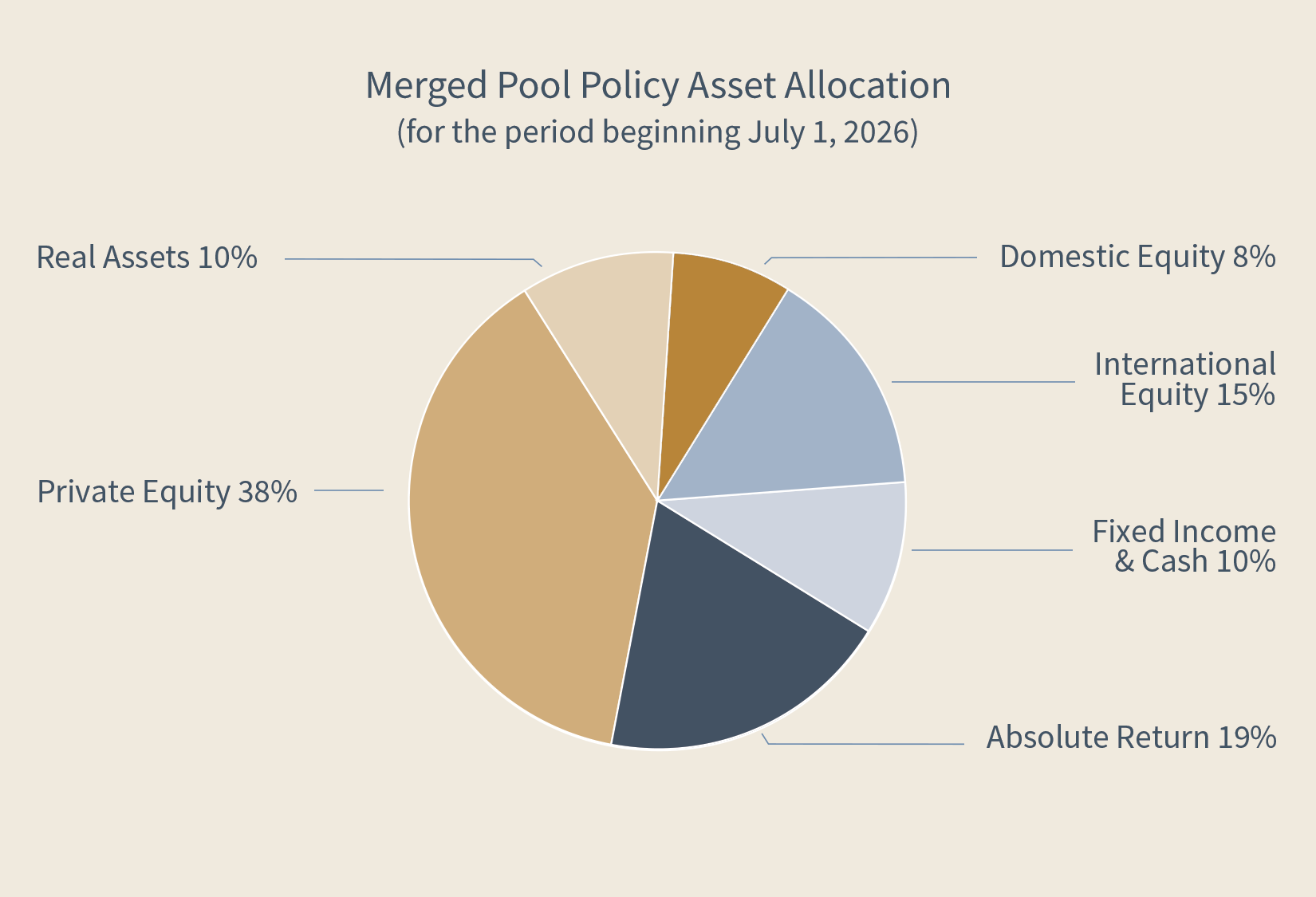
Are SMC’s investments mostly in publicly traded stocks?
SMC does own public stocks. However, the Endowment’s long-term orientation allows for a reasonable amount of illiquidity in exchange for higher expected returns. For this reason, roughly half of the portfolio is invested in less liquid asset classes like private equity and real assets.
What sort of time horizon does SMC consider when making investments?
Given the perpetual nature of the endowment, SMC naturally has a long-time horizon upon which to base its strategy. SMC focuses on outcomes five and ten years after deploying capital. SMC primarily focuses its investments on businesses and assets that provide valuable goods and services to their customers in the long run.
SMC’s long-term focus makes it critically important to thoroughly consider environmental, social, and governance factors in its work, since these factors clearly impact the value of businesses and assets in the long run. This important aspect of SMC’s work is described in its Ethical Investment Framework.
How does SMC select its investment partners?
To help optimize returns, SMC works with external investment partners across the world. These partners are carefully selected for their investment capabilities, knowledge, and alignment of interests with Stanford. SMC focuses on partners who have a thorough and repeatable process that incorporates relevant qualitative and quantitative information, have superior judgment concerning risk and return, and an investment time horizon that allows SMC to optimize returns and liquidity needs. Where appropriate, partners must be able to add strategic and operational value to their holdings. Importantly, SMC’s investment partners must have financial and fiduciary interests that are closely aligned with Stanford’s interests, and they must invest in a manner consistent with the Ethical Investment Framework.
Why are SMC’s partners and investments confidential?
Adding value to the Merged Pool through the careful selection of partners and investments is difficult, specialized, and highly competitive work. Disclosure of detailed information about investment partners could erode SMC’s competitive advantage and adversely affect investment performance. Comprehensive information about SMC is reviewed regularly by SMC’s Board of Directors, which includes Stanford’s President and the Chair of the University Board of Trustees.
What is the Ethical Investment Framework?
The Ethical Investment Framework (“EIF”) summarizes how SMC considers environmental, social, and governance factors in its investment work. Reflecting considerations of longstanding importance to the Endowment and the University, the EIF was developed by SMC in 2018 and formally adopted by the Board of Trustees soon thereafter. The EIF makes clear that environmental, social and governance issues are important considerations in SMC’s investment decisions. Companies or industries that disregard human or environmental welfare do not normally represent attractive long-term investment opportunities. SMC strives to prudently balance all factors that can alter risk and return in the endowment portfolio, so it must incorporate these factors into its investment analysis, just as it considers other factors and risks. This is true at the level of SMC’s strategic asset allocation, but also at the more granular level of partner and investment selection.
Can Stanford’s Trustees require SMC to divest from a company or industry?
Stanford’s Trustees have established specific criteria for those occasions when they will consider requiring divestment on moral grounds. As underscored in the Statement on Investment Responsibility, which was updated in 2018, the criteria state that the actions of the company or industry in question be “abhorrent and ethically unjustifiable.” The Trustees’ Special Committee on Investment Responsibility (SCIR) is charged with considering these and other investment responsibility issues, as well as petitions for divestment, and when appropriate, making recommendations to the full Board of Trustees. For more information, see the Trustees’ Statement on Investment Responsibility.
What is SMC’s broader role in the community?
SMC’s principal work is the careful stewardship of the Merged Pool. Certain schools and departments also own assets that they invest and manage directly, and for which SMC provides administrative support. SMC also contributes to academic life at Stanford by teaching an undergraduate economics seminar on investment management, while members of the SMC senior staff co-teach or guest lecture in a variety of courses throughout the University’s graduate and undergraduate schools. Finally, through its internship program, SMC provides a talented group of students with a hands-on introduction to the office’s work and a perspective on investment careers.

Stanford Management Company
635 Knight Way, Stanford, CA 94305
(650) 721-2200 | info@smc.stanford.edu